Got a small patch of hard, uncomfortable skin on your foot? It could be a corn or a plantar wart. Either way, be glad you’re living in the 21st century, when we no longer treat corns with crushed beetles or arsenic, nor suggest you rub a snail on a plantar wart to transfer the problem to it before skewering the poor creature!
Plantar warts and corns may initially seem similar, but they’re actually quite different conditions and it’s important to know which one you’re dealing with. Treating the wrong problem won’t work and may potentially irritate healthy skin.
What is the main difference between a plantar wart and a corn?
The key difference is the cause, because treatment decisions flow from that.
A plantar wart is caused by the human papillomavirus (HPV), which enters your body through a break in your skin. A corn, on the other hand, is not contagious and usually relates to your footwear or underlying biomechanics. It’s a small patch of thickened skin with a dense core above the area of greatest friction or pressure.
Plantar wart vs corn: a quick comparison
Although plantar fasciitis is a very common cause of heel pain, it’s not the only one. These patterns help narrow the possibilities, but symptoms can overlap. Podiatrists are trained to differentiate between similar conditions to reach an informed diagnosis.
| Plantar wart (verruca) | Corn | |
| Location | Soles of the feet. | High-friction areas, e.g. top or sides of toes, between toes, sides of feet, soles of feet. |
| Appearance | Rough, grainy surface; may see black dots in the middle (clotted blood vessels), may appear in clusters, may be surrounded by yellow skin. | Small, hard, yellowish bump. |
| Skin lines | Interrupted – curve around the wart. | Continue uninterrupted. |
| Painful | May hurt if squeezed. | May hurt under direct pressure. |
| Cause | Human papillomavirus. | Constant friction or pressure. |
| Contagious? | Yes. | No. |
| Goes away on its own? | Eventually – but could take 6 months to 2 years and may spread during that period. | No, though may be less noticeable if the source of pressure is removed. |
| Treatment aims | Stimulate your immune system to fight off the virus. | Remove the corn and prevent recurrence. |
| At-home treatment (diabetics should seek medical advice first) | Over-the-counter products from the pharmacy. | Soak feet to soften, then gently file down the corn with a pumice stone. |
| Podiatry treatment | Options include:
| Removing the entire corn with a scalpel. Advising on suitable footwear, padding or orthotics to prevent further friction. |
What does a plantar wart look and feel like?
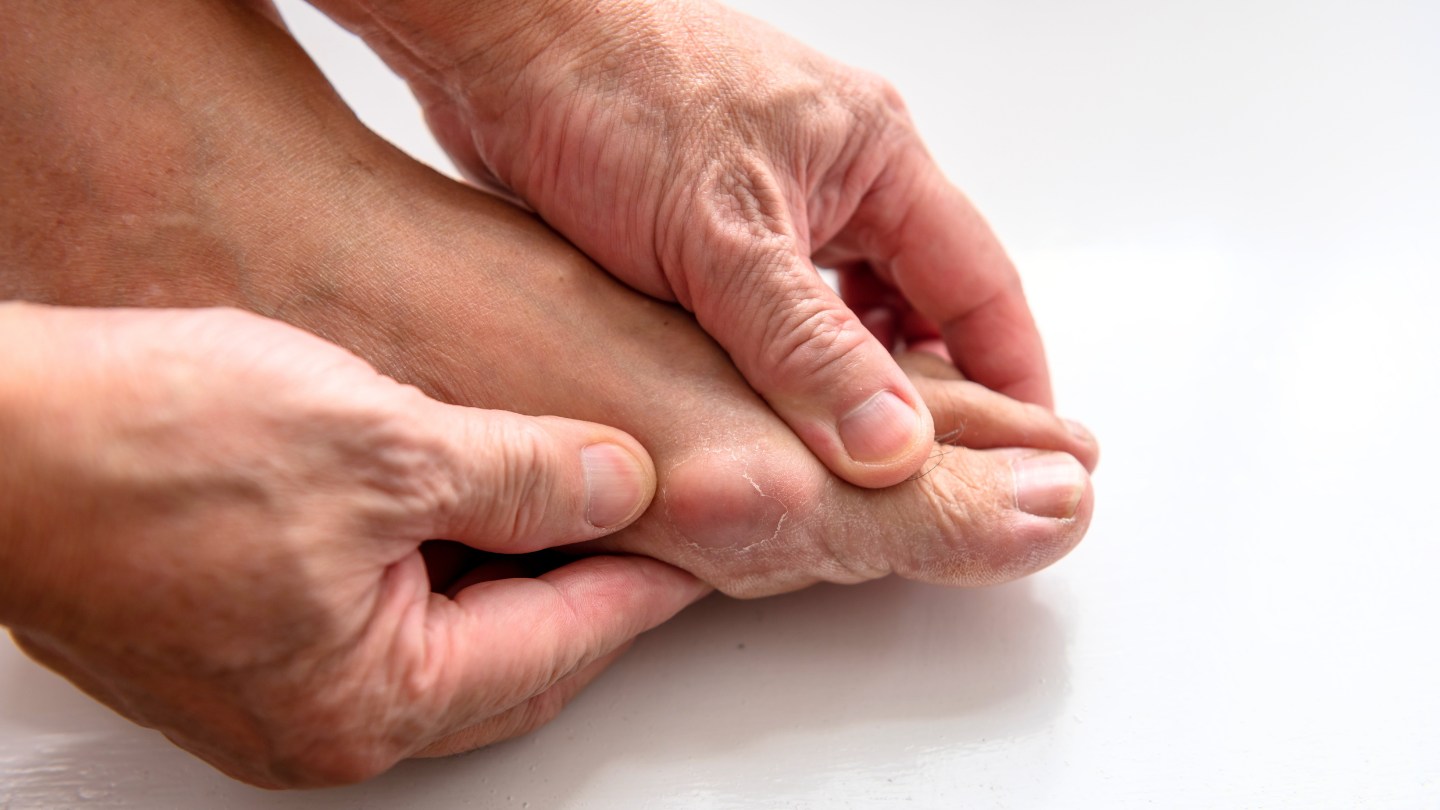
A plantar wart looks like a patch of thickened, yellowish skin with a rough area in the middle that may be an off-white colour with a bubbly texture, dotted with black or brown specks (dried blood clots). You may notice that your skin lines bend around it, like a path around an obstacle.
Plantar warts may be tender and painful, and may bleed on occasion.
Read our blog on Why plantar warts are more than a cosmetic concern
Can you catch a plantar wart from swimming pools or changing rooms?
Yes, plantar warts spread through sharing socks, towels or shoes, or by walking barefoot on an infected surface in a warm or wet place like a pool, sauna or gym.
What does a corn look and feel like?
A corn looks like a small, hard bump that may hurt when it’s pressed, sometimes giving you the sensation of walking on a small pebble. That’s because a corn has an inward-pointing core that can press on your nerve endings.
Read our blog on Corns on your feet.
How to tell if you have a corn or wart
The best way to tell if you have a corn or a wart is to see a podiatrist. We’ve had years of training and experience distinguishing between these two common foot problems.
At home, the easiest way is to look for the following signs of a viral lesion (wart):
- Interrupted skin lines: if they detour around the spot, it’s probably a plantar wart, not a corn
- Pain: if it’s more painful when squeezed, it’s probably a wart (corns are more painful under pressure)
- Black or brown specks: these are visible blood vessels supplying a wart with nutrients (most types of corn do not contain blood vessels).
- Clustering: Warts will sometimes cluster together, forming a mosaic. Corns don’t tend to do that.
Still not sure what’s on your foot?
Guessing can mean weeks of the wrong treatment, and warts can spread in the meantime.
What about a callus?
A callus is a hard, thick patch of skin. Some callusing is quite normal, particularly on the areas of your feet that carry the most weight, like your heels, big toes, the balls of your feet and the sides.
From time to time, it may be worth soaking your feet, gently rubbing callused areas with a pumice stone, and applying an intense moisturiser. This helps soften your skin and prevent skin cracks from developing, which can trigger an infection.
Corns are essentially a particular type of callus – a small one, with a hard, painful centre.
Why do plantar warts and corns need different treatment?
Because they have different causes. Plantar warts are caused by a virus, and we need to help your immune system fight it off.
Corns are caused by repeated friction, and we need to adjust your footwear or support your biomechanics to reduce pressure on that area going forward.
What should you avoid doing at home?
For both corns and plantar warts, please avoid:
- Treating the wrong condition!
- Using any sharp tools to dig it out – DIY podiatry can cause injury and infection
- Treating foot conditions yourself if you have diabetes, peripheral neuropathy or any other condition that reduces sensation in your feet.
For plantar warts specifically, please avoid:
- Spreading them to others – don’t walk around barefoot or share pumice stones, nail clippers or towels
- Spreading them to other parts of your body – try not to pick, scratch or shave it.
For corns specifically, please avoid:
- Ill-fitting footwear, whether it’s too tight or too loose
- Irritating surrounding skin with ill-fitting or overly strong medicated corn pads.
When should you see a podiatrist about a suspected corn or plantar wart?
If you’re otherwise in good health, we’d recommend you see a podiatrist if a few weeks of at-home treatment have not succeeded. If you have diabetes, peripheral neuropathy or any other condition affecting your nerves or circulation, it’s wise to come at the outset.
Hong Kong Foot Clinic’s skilled podiatrists can assess your feet, identify whether you have a plantar wart, corn or another condition, and provide appropriate treatment.
We debride corns carefully using sterilised scalpels, then we may assess your biomechanics and provide advice on footwear or orthotics to protect your feet. We can also offer more targeted plantar wart treatment than you can do at home, including higher-strength topical agents and cryotherapy.
We’re open Monday to Saturday, with late evenings until 7 pm on Monday, Tuesday and Thursday.
Disclaimer
All information is general and not intended as a substitute for professional advice. Any surgical or invasive procedure carries risks.
References [Accessed 26 October 2026]
- Mukhopadhyay AK. Foot that hurts: A brief note on the history of corns and calluses. Indian J Dermatol Venereol Leprol 2021;87:885-9. https://ijdvl.com/foot-that-hurts-a-brief-note-on-the-history-of-corns-and-calluses/
- Lisa Murphy, Anne-Marie Tobin, H17 Traditional medicine: a warts-and-all tale, British Journal of Dermatology, Volume 188, Issue Supplement_4, June 2023, ljad113.299, https://doi.org/10.1093/bjd/ljad113.299
- Cleveland Clinic, Plantar warts, https://my.clevelandclinic.org/health/diseases/24899-plantar-warts
- Harvard Health Publishing, What are corns and calluses? https://www.health.harvard.edu/skin-and-hair-health/corns-and-calluses-a-to-z
- DermNet, Viral wart, https://dermnetnz.org/topics/viral-wart
- DermNet, Corn and callus, https://dermnetnz.org/topics/corn-callus
- Cleveland Clinic, Corns and calluses, https://my.clevelandclinic.org/health/diseases/16896-corns-and-calluses